Summary: A hands-on tactical guide to Germany's starting lineup, breaking down the 4-2-3-1 that shifts into a
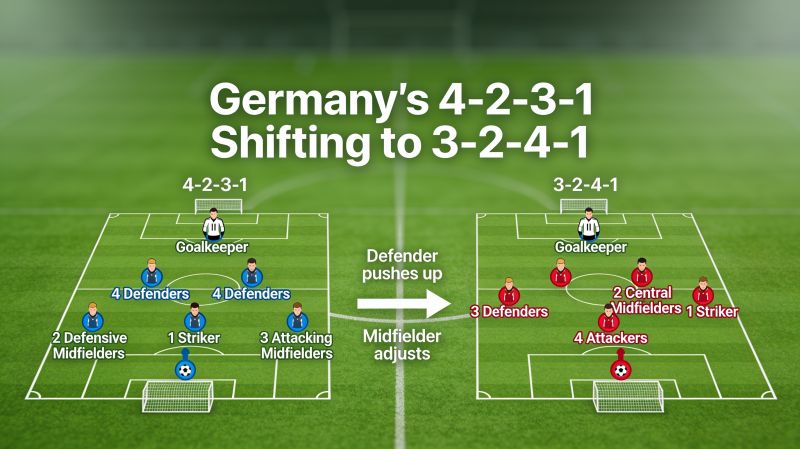
Germany's starting lineup often looks like a 4-2-3-1 on paper。but watch the first ten minutes and you'll see it morph into a 3-2-4-1 in possession. Joshua Kimmich drifts from right-back into central midfield, Antonio Rüdiger steps out with the ball, and suddenly the shape is unrecognizable from the broadcast graphic. That fluidity is the point — and it's also where things get fragile. I watched the March friendly against France twice, and the buildup pattern was identical: Kimmich tucks in, İlkay Gündoğan drops to receive, Jamal Musiala drifts left. It works until a quick counter punches through the space Kimmich vacated.So who actually starts when everyone's fit?Manuel Neuer is the undisputed No. 1 — his distribution under pressure still buys Germany ten extra yards of territory per goal kick. The back four is where the real debate lives. Rüdiger and Jonathan Tah are the likely center-back pairing, with Nico Schlotterbeck pushing hard. At full-back, Kimmich on the right is non-negotiable, but the left side is a coin flip between David Raum's crossing and Maximilian Mittelstädt's defensive solidity. I'd lean Raum against low blocks。
Mittelstädt against elite wingers. That's not indecision — it's matchup logic.The double pivot shapes everything. Robert Andrich brings the bite — he's the guy who commits the tactical foul at midfield so nobody notices the counter starting. Partner him with Pascal Groß for control, or Aleksandar Pavlović for legs?Groß's passing range is better, but Pavlović covers ground faster. Against Spain-type possession teams, you need Groß's calm. Against France's transition speed, Pavlović's recovery runs matter more. Florian Wirtz is locked in as the No. 10。and Musiala starts left — those two combine like they share a brain. On the right, Kai Havertz or Leroy Sané?Havertz offers aerial presence and pressing angles;Sané gives you one-v-one danger but inconsistent tracking back. I'd start Havertz in knockout games and Sané when Germany expects to dominate the ball.
Up top, Niclas Füllkrug is the pure No. 9 — limited in build-up, lethal in the box. Havertz as a false nine changes the entire pressing structure, pulling center-backs out of position for Wirtz's late runs. The choice depends on whether Germany wants to pin the opponent deep or disrupt their first pass. That's not a small tactical detail — it's the difference between controlling a game and chasing it. Nagelsmann has shown he'll switch between the two within the same match。which keeps opponents guessing but risks confusing Germany's own rhythm.Here's the practical takeaway for anyone tracking Germany's starting lineup: don't memorize the XI, memorize the roles. Kimmich as inverted full-back. Andrich as the foul-giver. Wirtz as the free-roaming creator. When those three roles are filled correctly, the names around them matter less. When one is missing — say Kimmich is forced to stay wide — the whole possession structure wobbles. That's the real story of Germany's lineup, and it's why predicting the XI is less useful than understanding how the pieces fit.